



When Cracker Barrel (CB) reversed its rebrand and reinstated the old logo, it seemed like a win for nostalgic fans. But was it really the right move?
By caving to the backlash, Cracker Barrel missed a once-in-a-brand-lifetime opportunity to connect with its fans and strengthen its brand with the next generation.
Instead of backpedaling, they could have reframed the update as a way to honor tradition with a future-forward approach.
@spaceboycole @Cracker Barrel needs new designs
♬ original sound - Cole Poska
One designer on TikTok showed hilarious examples of Herschel-branded marketing ideas that resonated because they were fun, nostalgic, and self-aware.
There are creative ways they could have recovered without backpeddling. The fallout was due to the perception that corporate heads ditched Uncle Herschel and were erasing tradition.
To say the rollout was rocky is an understatement. Loyal customers felt blindsided. Uncle Herschel (the man on the barrel) was erased without warning. The backlash on social media was fierce.
The mistake wasn’t in the logo. The big fail was in how they introduced it.
The reversal wasn’t a win for the brand. It was a knee-jerk reaction that missed a win in a monumental moment.
In a massively speedy about-face, Cracker Barrel reversed course. After spending an astounding $700 million on the rebranding, with stock value plummeting to $100 million, they officially tossed the updated logo and reinstated the old one.
How fast was the about-face? Just one week!
Forbes reports that on August 19, 2025, Cracker Barrel announced the new logo.
Six days later, on August 25, the company posted on its website that “they were listening” and “could’ve done a better job sharing who we are and who we’ll always be.”
The next day, August 26, the company announced that they were going back to the logo featuring Uncle Herschel and the barrel.
Millions of dollars were wasted, and the leadership steering the ship changed course like a tiny sail boat in a shifting wind. If I owned a Cracker Barrel franchise, that would shake my confidence beyond comfort.
Instead of leading fans through the change, the executive team surrendered to the uproar.
Cracker Barrel lost more than money and stock value. The leadership lost credibility.
Let’s recap: Last month, I covered how Cracker Barrel unveiled a cleaner, simplified version of its logo. I argued that the existing logo had too much detail, was mottled, and looked awful when scaled down. It needed to be cleaned up for the demands of a contemporary franchise for use in social media, digital applications, merchandise, and more.
Our team has opinions about how the new logo could be improved. Brand identity is our thing, so of course we have to take a stab at it!

Even with our critique of the new logo, we thought its implementation in menus, ads, and packaging was clean, appealing, and well executed.
At the center of every brand, there is a purpose. It’s the reason why they do what they do. Cracker Barrel’s leadership made a critical error in that they didn’t tie the purpose of rebranding to the tradition and heritage of the company.
Julie Masino, Cracker Barrel CEO, is quoted as saying that the purpose of the rebranding is because “Cracker Barrel needs to feel like the Cracker Barrel for today and for tomorrow.” What??? The whole vibe of the Cracker Barrel experience is nostalgia for a place and time gone by!
Consumer brands survive with customer loyalty. Masino proved that she was severely out of touch with the company’s loyal base.
The new logo wasn’t the real issue. The failure was in the communication.
Cracker Barrel could have invited its loyal fans to the rebranding party through social media, in-store displays, and table tops.
Let me be clear: I’m not suggesting that consumers would vote on logo concepts. That would be a nightmare.
My point is that, while to some, changing a logo may be a small part of the brand identity, it can bring out strong emotions. In our 30+ years in the business, we’ve seen it, even in small mom & pop shops!
Imagine if CB had created a survey with a chance to win Cracker Barrel gift certificates.
The survey would have clearly explained reasons why the logo needs to change: that a cleaner logo was necessary for digital and merchandising use.“The Old Country Store” descriptor was not clear, etc.
The questions would be fun and a great way for the corporate heads to get a pulse on their loyal customers. The survey would also be part of a campaign to prime people for change.
Questions that give people the real sense that their opinion matters. For Example:
What do you know about the guy next to the barrel?
His name is Herschel. T/F
He founded Cracker Barrel. T/F
He was famous for his biscuits & gravy. T/F
Why is there a barrel in the logo?
It dates back to the Prohibition era, when the practice of making homegrown whiskey was prevalent. T/F
Biscuit flour was purchased and stored in barrels. T/F
The first Cracker Barrel had barrels for tables. T/F
What is the most important part of the logo to you?
The guy next to the barrel. T/F
The barrel. T/F
The font. T/F
The logo doesn’t matter as long as the food and service keep me coming back! T/F
A survey and contest would have alerted brand loyalists to the reason for the change and invited them to share their opinions.
Other questions could have been included in the survey to learn more about what was important to customers and what they couldn’t live without.

Then, when CB began to build on the rebranding momentum, they could have created merch that celebrated the tradition of Cracker Barrel serving future generations.
Imagine if Cracker Barrel had created a fun campaign, like “Join us for the Cracker Barrel 2025 Rebranding: The Old Country Store Stokes a New Generation!”
They could explain the reason in stores on paper menus or table cards with something like this:
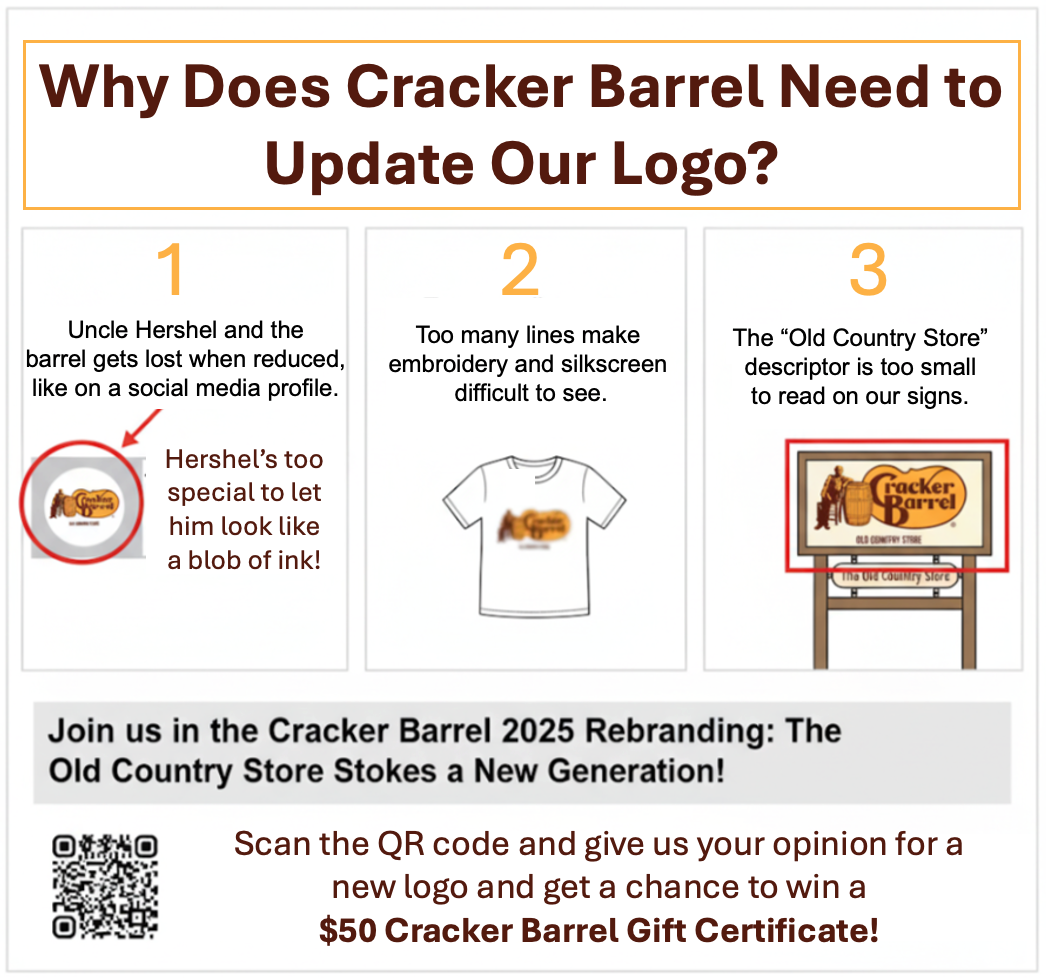
“Why Cracker Barrel’s Logo Needs an Update,” pointing out 3 things hindering the logo:
Join us for the Cracker Barrel 2025 Rebranding: The Old Country Store Stokes a New Generation!
Scan the QR Code and give us your opinion for a new logo and get a chance to win a $50 Cracker Barrel Gift Certificate!
When the time came for the rollout of the new logo, it would not have come as a surprise to fans. And instead of the company saying “we heard you” after the outrage had exploded, they could have said:
“We heard you and here’s what you said about the Cracker Barrel you love!” Here are the top responses from our surveys:
So, we kept the bold, traditional font to honor the legacy. Creative graphic designers flipped the barrel to its side, doubling it as a backdrop. And Uncle Herschel is going to take a more prominent place as the official Cracker Barrel host!
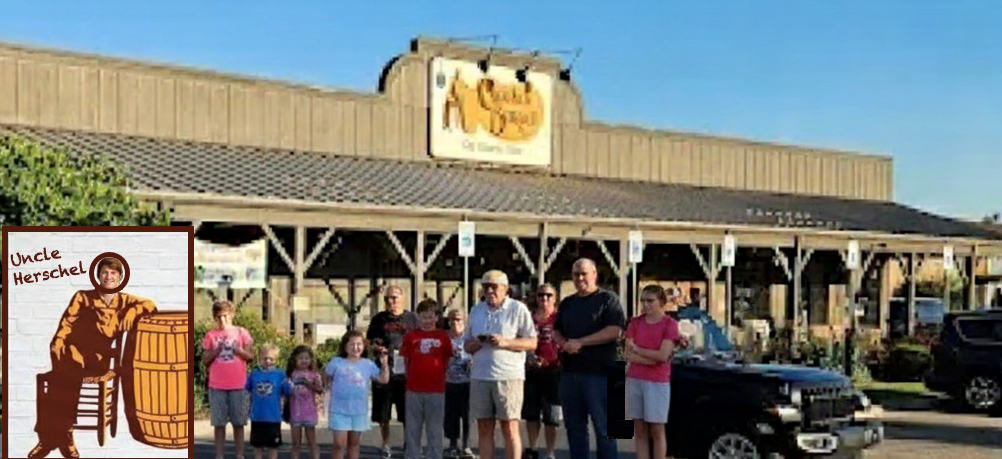
Instead of erasing Uncle Herschel, Cracker Barrel could have reintroduced him as a mascot and woven him more deeply into the brand experience.
Imagine Herschel on playful merch, on restaurant signage, menus, and in social media campaigns.
Customers love tradition, but they’ll accept change if they understand why it’s necessary and if it’s done well. Did you hear McDonald’s fans flip out when the chain remodeled its stores? The remodels and menu upgrades keep McDonald’s fresh and relevant without overhauling the brand.
That’s the opportunity Cracker Barrel missed: turning Herschel into a bridge between old and new, rather than a traditional icon that appeared to be insensitively discarded.
I have a dear friend, Evelyn, who grew up in the southern US, and when she moved north to Michigan in the 80s, she became a loyal and frequent Cracker Barrel customer. She loved the comfort food: biscuits and gravy, fried chicken, and apple dumplings.
When I asked her about the rebranding, here’s what she said: “If they had asked me, I would have suggested that they not spend the money on redesign, but return to their old way of making good food. I’ve been a loyal customer since the 1980s, and the food has gone down in quality and flavor over the last 10 – 12 years. Oh yeah, and bring back the apple dumplings!”
Instead of caving, Cracker Barrel could have doubled down on loyalty-building campaigns, such as:
The creative potential for Uncle Herschel’s gags, games, and wearables in the Old Country Store is boundless.
This would have done more than honor their most loyal customers: it would have engaged new ones in the fun.
The backlash wasn’t limited to the logo. Remodeling the restaurant design also became a flashpoint. Cracker Barrel’s trial run of a minimalist store concept stripped away much of the “cluttered nostalgia” fans associate with the brand.
This, too, was a mistake. People don’t want a sterile Cracker Barrel; they want the cozy, cluttered, authentically old-country experience.
The solution isn’t minimalism. It’s refreshing to finish and update booths while preserving the warm, lived-in feel that customers equate with authenticity.
By reinstating the old logo, Cracker Barrel signaled that backlash, not brand vision, drives its decisions. This kind of move erodes confidence in leadership. A brand has to own its strategy, explain it clearly, and invite people into the story.
In an interview, Megyn Kelly challenged Cracker Barrel’s leadership, that they should be held accountable.
Backpedaling doesn’t build loyalty, it shows uncertainty. And uncertainty is far more damaging than a logo that people need time to warm up to.
There are also potential long-term consequences for Cracker Barrel beyond the immediate financial loss. How might this affect their ability to modernize in the future?
The Cracker Barrel saga is a lesson for every brand: rebranding isn’t just about a new look. It’s about telling the story of a company’s purpose, helping people relate to the change and executing a rollout with positive momentum.
You can modernize without erasing tradition. You can evolve while still honoring the symbols that people hold dear. But only if you’re clear on the purpose and communicate it consistently and creatively.
_____________
Strong brands are built on purpose. Identity Creative guides leadership teams to clearly identify the purpose of the brand. Creativity flows from that purpose to everything from marketing and sales to packaging and video.
Brand-FIRST!